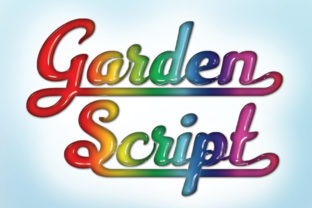
Garden Script: A Linguistic Horticulture of Visual Expression
In the vast landscape of written communication, most scripts serve as efficient vehicles for language. They are tools designed for speed, clarity, and standardization. Garden Script emerges from a fundamentally different soil. It is not merely a font or a typeface; it is a constructed script system comprising over 2500 unique glyphs, each cultivated not solely for phonetic representation but for visual meaning and aesthetic possibility. To understand Garden Script, one must shift perspective from linguistics to a form of visual semiotics, where the shape of a character carries narrative weight alongside its sound.
The Botanical Architecture of the Glyphs
The core characteristic of Garden Script is its immense glyph set. Unlike alphabets with 20-30 letters or syllabaries with a few hundred characters, this script's inventory is expansive. Each glyph is a distinct design, often incorporating organic, flowing lines, interlocking forms, and motifs reminiscent of natural growth—twining vines, layered leaves, radial symmetry. The name "Garden" is apt; the script feels cultivated, each character a hybrid of artistic intent and functional role. The glyphs are not random. They are organized into families based on visual themes and phonetic associations, creating a coherent yet richly varied ecosystem of symbols.
For professionals in design and visual arts, this presents a unique palette. A single word written in Garden Script can become a miniature illustration, its meaning subtly underscored by the shapes chosen. For instance, a word related to "growth" might be composed of glyphs from the "ascendant" family, featuring upward-curving terminals. This layer of embedded visual metaphor is a primary advantage of the system, offering a depth of expression that standard typography cannot.
Real-World Applications in Creative Fields
The practical applications of Garden Script are naturally niche but profoundly impactful within specific contexts. Consider its use in branding and identity design for companies whose ethos is tied to nature, craftsmanship, or intricate detail. A luxury artisan brand, a botanical research institute, or a studio specializing in handmade goods might adopt Garden Script for its logotype or key branding elements. The script communicates complexity and care before a customer reads a single sentence.
In publishing, particularly in speculative fiction or poetry, Garden Script offers a tool for visual storytelling. A book cover or chapter title rendered in these glyphs can instantly set a tone of otherworldliness, organic mystery, or ancient wisdom. Educators and researchers in the fields of semiotics, art history, or constructed languages study Garden Script as a case study in the intersection of form and meaning. It serves as a practical example of how script design can influence perception and carry cultural weight beyond mere alphabetics.
Workflow Integration and Considerations
Implementing Garden Script is a deliberate process. It is not a script one uses for drafting documents or writing quick emails. Its utility shines in finished, intentional design work. A typical workflow involves selecting a base language concept—often English or another language for its phonetic framework—and then mapping those sounds or concepts to appropriate glyph families from the Garden Script set. This is a curatorial process. A designer might choose glyphs for the word "root" from the "fundamental" family, which features dense, nested geometric forms, to reinforce the concept visually.
Key considerations are paramount. Legibility in a traditional sense is secondary to evocative legibility. Garden Script is not optimized for rapid reading of long texts; it is optimized for impactful presentation of short phrases, titles, names, or key terms. Furthermore, accessibility must be thoughtfully addressed. In digital use, alt text describing the verbal content and the visual intent becomes crucial. Another consideration is the learning curve. For a creator to use Garden Script effectively, they must develop familiarity with its glyph families and their associations, moving beyond a simple substitution cipher to a more nuanced selection process.
Comparative Perspective with Other Script Systems
When placed alongside other scripts, Garden Script's uniqueness clarifies. Compared to artistic calligraphic styles like Arabic thuluth or Chinese seal script, Garden Script is not a style of an existing alphabet but a standalone system with its own internal logic. Compared to constructed scripts for fictional worlds, like Tolkien's Tengwar, Garden Script is designed for real-world aesthetic application rather than linguistic completeness for a fictional culture. Its closest relatives might be certain complex symbolic systems like alchemical sigils or some heraldic codes, but it distinguishes itself by having a structured, scalable framework of over 2500 elements designed for contemporary creative use.
This scale is a significant advantage for versatility. A hobbyist creating a personal sigil or a family crest can find a unique combination within Garden Script that feels personally resonant. A business owner seeking a trademark that is inherently difficult to copy due to its complexity might find value here. The script offers a reservoir of uniqueness that is hard to replicate with standard font libraries.
The Role in Cultural and Personal Expression
Beyond commercial and professional use, Garden Script holds potential for personal and cultural expression. In communities or groups seeking a visual identity that feels distinct from mainstream typography, adapting elements of Garden Script for logos, insignia, or ceremonial documents can create a strong sense of visual cohesion and shared identity. Its glyphs can be used to encode meanings in a way that is publicly visible yet privately understood by those familiar with the system's associations, adding a layer of communal belonging.
For individual creators, such as artists, poets, or even gardeners keeping intricate journals, the script can transform notation into art. Recording a plant's name in a journal using a glyph from the "floral" family imbues the note with an artistic quality that a standard written name lacks. This blurring of the line between writing and drawing is perhaps the script's most compelling attribute. It answers a latent desire in many creators to make every aspect of their output, even the text, carry aesthetic intention.
Observations from early adopters suggest that using Garden Script changes one's relationship to writing. It becomes a slower, more meditative process. Selecting glyphs is an act of composition akin to choosing colors or brush strokes. This can be a benefit in contexts where mindfulness and deliberate creation are goals, but a limitation in contexts requiring speed and efficiency. The script, therefore, self-selects its applications and users, thriving where time and care are invested.
Technical Implementation and Future Trends
From a technical standpoint, Garden Script exists primarily as a digital font file and a corresponding reference guide mapping glyphs to phonetic inputs or conceptual keys. Current implementation relies on OpenType features or specialized software that allows glyph selection via custom keyboards or pull-down palettes. Its use in web design is growing but requires careful handling to ensure the glyphs render correctly across platforms and that SEO text alternatives are properly provided. The semantic content of a phrase written in Garden Script must be duplicated in a standard script for search engines and accessibility tools, a necessary step for practical online use.
Trends in design are moving towards greater customization and authenticity. Garden Script aligns with this movement by offering an off-the-grid visual language. It avoids the homogenization that comes with widespread use of common web fonts. As augmented reality and immersive digital experiences develop, scripts with high visual information and symbolic depth like Garden Script may find new applications in environmental text and interactive storytelling, where a glyph can be an explorable visual object as well as a readable character.
The journey into understanding and using Garden Script is not a path toward replacing conventional writing. It is a parallel path toward enriching communication where the visual channel is paramount. It stands as a testament to the fact that writing can be more than a code for speech; it can be a garden of signs, where each chosen form contributes to the beauty and depth of the message being grown. For those whose work or passion lives at the intersection of word and image, Garden Script provides a unique and fertile ground for cultivation.